
Click here for Editorial II: Berkeley’s Next Council Must Learn to Govern
In this Editorial we want to talk about the state of our democracy—locally as well as nationally.
The concern is not just about Trump’s voter suppression, which could yet buy him a Republican Congress in November.
Democracy is about much more than voting. Without leaders who listen to their constituents, and who tell the people the truth, the cleanest of elections will not bring good government.
Under Donald Trump, the nation’s culture has been shaken to its core over the past ten years. Truth itself has become more a joke than a civic requirement. It was Kellyanne Conway, Counselor to Trump, who used the phrase “alternative facts” to defend what were actually lies.

A top aide to George W. Bush, probably his senior advisor Karl Rove, said that that critics and journalists lived in the “reality-based community,” defining them as people who “believe that solutions emerge from your judicious study of discernible reality….
“That’s not the way the world really works anymore. We’re an empire now, and when we act, we create our own reality.”
Berkeley Speaks is not saying that we have become a nation of lying Trumpers. But we live in a culture where “truth” is what is politically convenient, and where it is increasingly hard to tell real intelligence from artificial intelligence. This culture has a corrosive effect on everyone’s morality. It’s important that we hold ourselves, and our leaders, to a higher standard of truth-telling if we are to demonstrate what it means to practice reality-based policymaking.
Tell the truth about surveillance.
Let us take the example of mass surveillance. In Berkeley we have been struggling with this issue for a year now, since the expanded contract with the Flock Group was first proposed by the police department. Surveillance has emerged from a background-noise issue to become a focus of national debate. It is now a flashpoint in Berkeley’s election campaign.
As the city council and city administration have become increasingly under siege, the proponents remain insistent that mass surveillance is essential to Berkeley’s public safety.
Let’s look at how their defense of the surveillance proposals has become increasingly insupportable.

Mirroring the rhetoric of the police department and the vendor, some council members mislead the public that license plate readers and other surveillance tools will bring great benefit, that Berkeley’s surveillance data is protected from the federal government, and that all we collect is a license plate number that is public information.
On these three crucial concerns about mass surveillance, the proponents’ arguments have been shown to be false.
- When Berkeley government leaders tell us that ever-present camera, video, and drone surveillance will cause crime to plunge, while studies show the technology has very limited benefit, they are wasting millions of dollars in a clear example of fiscal irresponsibility.
It has not been proven how much ALPRs contribute to solving crimes, but it is broadly accepted that they do not prevent crime; most often they just shift it to a different location.
Even the “clearance rates,” the rate of solving crimes that have already happened, show no significant reduction after ALPR installation.
For documentation, see https://bams.network/ and https://www.deflockapex.org/alpr-evidence
- When the leaders say that laws, policies, and contract language will prevent our residents’ data from the authoritarian government in Washington, while they know these protections will not restrain Trump, they are showing that their commitment to immigrants and to the First Amendment is hollow.

The Electronic Frontier Foundation (EFF) explains, “Automated license plate readers (ALPRs) build a searchable map of everywhere a driver goes, fed into databases that police, ICE, and private vendors can query after the fact.
“Networked across a city, ALPRs are purpose-built to track everyone regardless of suspicion.”
The EFF concludes, “ALPRs are not a surveillance tool that can be made safe with the right policy or feature update—they are irredeemably harmful.”
- When leaders insist that “all we collect is a license plate number that is public information,“ though they know that license plate readers can glean much information about the car, the driver, and the driver’s personal habits from the photos of the car, they are putting the safety of every resident and visitor in Berkeley at great risk, the opposite of their public service mandate and their oath of office.
The Department of Homeland Security itself reported: “Some ALPR systems are capable of augmenting character recognition with vehicle recognition features including identifying vehicle make, model, color, and direction of travel. Using AI, the software analyzes either the full-frame image taken for plate recognition, or a separate photo taken specifically of the entire vehicle, comparing the shape and distinct features of the vehicle against a database of known vehicles.”
See https://www.dhs.gov/sites/default/files/2025-06/25_0606_st_lprmsr.pdf
Tell the truth about homeless sweeps.
Berkeley’s difficulty telling the truth is not confined to the issue of surveillance. There is also a great disparity between the City’s rhetoric and practice on the unhoused.
“California Gov. Gavin Newsom has urged localities to adopt encampment bans on public land while stressing compassion and dignity. A memo following the adoption of Berkeley’s 2024 encampment policy update affirms the city’s primary ‘housing-first’ approach to homelessness and that it is a ‘care first, jails last’ jurisdiction.”
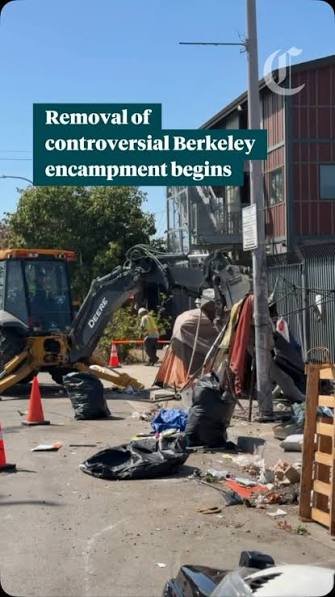
Credit: SF Chronicle
Those are fine words: compassion, dignity, housing first, care first.
But a July 14 ruling by U.S. District Judge Edward Chen cited “abundant — and troubling — anecdotal evidence of an enforcement framework weighted in favor of property disposal.
“These facts help illustrate both the breadth of the risk faced by the class [homeless individuals with disabilities in Berkeley], and the severity of the actual harms arising from the City’s challenged property seizure and destruction framework.”
Berkeley can do better.
Here are five crucial rules for making good government decisions.
- Government decisions must be made based on hard information that is available to everyone. Don’t make the decision first and then look for evidence to support it.
- Work hard to create solutions that serve the diverse, even conflicting needs of different parts of the community. That is part of what it means to “re-imagine public safety.”
- Really listen to the concerns raised by community members. Never say, “you elected me, so I get to make the decisions myself.”
- Follow the Precautionary Principle that is enshrined in Berkeley law since 2006. In the words of the Berkeley Peace and Justice Commission:
“The Principle is an approach to decision-making that prioritizes preventing harm to human health and the environment. The Principle shifts the burden of proof, requiring actions to be proven safe, rather than waiting for proof of damage to restrict them.”
Above all, keep social justice at the heart of all public programs. And have a bit of humility. Don’t use words like “compassion and dignity” to justify evicting unhoused people with nowhere to go.