A Victory—”If You Can Keep It.”
Please note: This is the lead article in a series in this edition of Berkeley Speaks on the topic of Flock contracting, mass surveillance, and the defense of Sanctuary. This article assesses the May 7 council meeting, what surveillance opponents won, and how that happened, and the need to keep up the struggle.
In separate articles, we look at three lessons learned in the campaign of the last year. These include:
- We go into more depth on how the campaign prevailed over Flock, and how the next phase of the campaign is likely to unfold.
- The danger of collaborating with the federal government agencies—not just ICE.
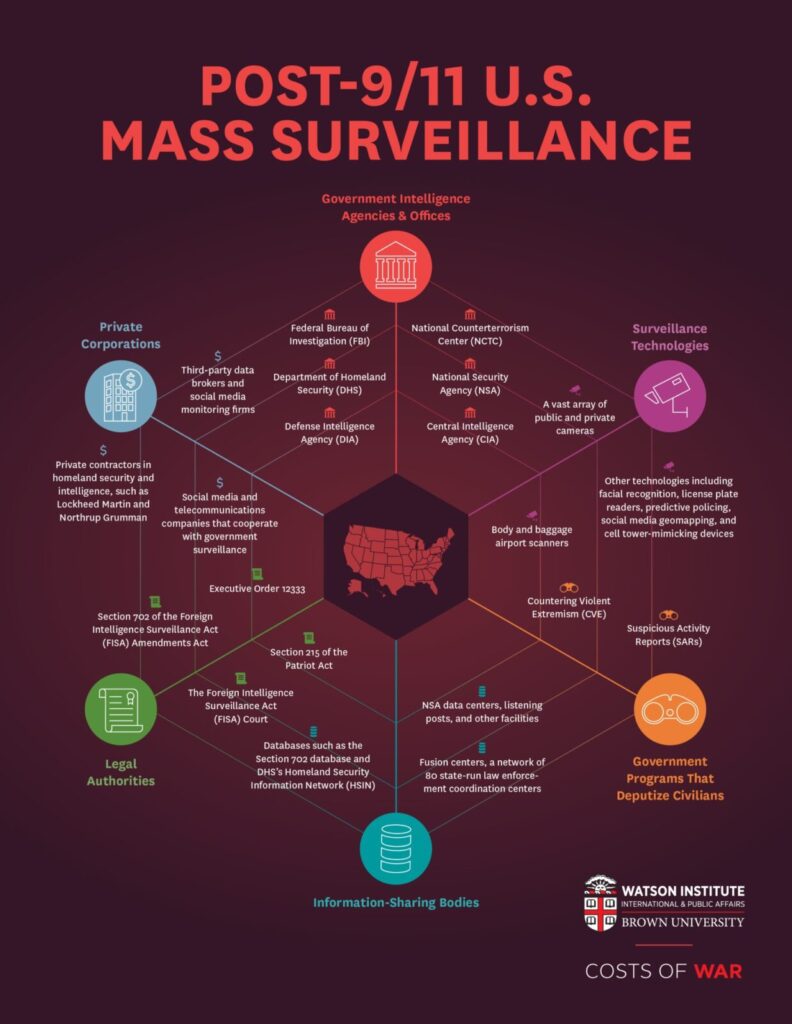
- What “mass surveillance” actually is, and how it is used against community members
Please also see:
- The draft RFP from City of Berkeley staff for Public Safety Technology (surveillance)
- Copy of Berkeley City Attorney Memo (leaked): “Legal Issues and Risks Relating to Flock“
- Breaking news:
- June 17 2026 SFPD Statement on ALPR Data Access
* * * See our Urgent Action Alert and come to the Tuesday June 30 Berkeley City Council meeting to speak up about the new surveillance RFP!
Thursday, May 7, 2026 was an important moment in the struggle over mass surveillance in Berkeley. That night’s city council meeting was the third since last fall to consider the police proposal for a greatly expanded surveillance program.
And for the third time in a row, nearly unanimous public opposition stopped the proposal. (For background, see “Stop Local Collaboration with Immigration” in Berkeley Speaks’ Fall 2025 edition.)

The cops’ complex request struck many as over-broad, incorporating mutiple sources of surveillance data as well as AI tools to manage them. As the proposal proceeded through the lengthy review process over the last year, thousands of Berkeleyans called, wrote, and spoke up to demand no BPD contracts with Flock. On May 7, two hundred people packed the city council chambers, with many more calling in.
In the end the council decided, for the moment, to maintain the status quo. The current contract for Automated License Plate Readers (ALPRs) will be extended a year to 2027. The proposed inclusion of other Flock systems, such as drones, Flock Nova investigative software, community video streams, a Real-Time Information Center (RTIC), and Condor PTZ fixed surveillance cameras was withdrawn for the time being. For explanation of the Nova and RTIC tools, see our article What “mass surveillance” actually is.
However, the Council continued the process of writing use policies for these technologies, making it easier to adopt them when a new contract is ready.
The Council directed city management to prepare a Request for Proposal (RFP) for competitive bidding from multiple surveillance providers.
The switch to competitive bidding is not the end of Flock’s chances for the expanded two million dollar contract. It is quite likely that Flock will be one of the bidders–possibly the only one. The police have already stated that Flock is the ALPR provider they prefer.
As of early June, an RFP has already been drafted by City of Berkeley staff. Key dates are July 6 to circulate it to potential bidders, proposals due back August 3, and a staff recommendation due on September 7.
*
May 7 represents a progressive victory that is worth studying. It is a complex story with a lot to unpack. It is also a rare win in the city’s recent history.
In the Fall of 2024, Berkeley Speaks editorialized that “the Berkeley we love is slipping away.” Social justice causes are facing increased resistance in areas such as homelessness, housing affordability, police accountability, government transparency, and the genocide in Gaza. So why has the Stop Flock campaign been more successful?
In this edition Berkeley Speaks will examine how a coalition of progressive interests were able to prevail in a cause that seemed virtually unwinnable. As we look forward to the next round of this struggle, we’ll discuss the issues likely to come up, and how the movement can position itself for a full win for privacy and Sanctuary.
A winning coalition

The fight against Flock began as a struggle for privacy rights and against mass surveillance.
Advocates from the privacy and civil liberties movements have long warned about the dangers of mass surveillance. The Fourth Amendment provides strong constitutional protections against unwarranted search and seizure, compared to some other countries.
Supporters of mass surveillance quote the judicial precedent that there is “no reasonable expectation of privacy in public spaces,” but a leaked opinion from the City of Berkeley’s own attorney warns that with the use of ALPRs becoming so widespread, we may be approaching the point where they violate the Fourth Amendment.
The Daily Cal published the opinion in a May 5, 2025 article titled “Leaked city attorney memo shows Berkeley risks potential million-dollar lawsuits if council renews Flock contract.”
The excerpt below has been edited for brevity by Berkeley Speaks. For legal citations and the full text, please see the memo at “Legal Issues and Risks Relating to Flock.”
(Note that the document that Berkeley Speaks received was somewhat corrupted. We have done what we can to make it readable. The City of Berkeley has not released the original version.)
“In Carpenter v. United States (2018), the Supreme Court held that individuals have a reasonable expectation of privacy in their cell-phone location data because it creates ‘an exhaustive chronicle of location information’ that can track the ‘whole’ of their movements.

“And in Leaders of a Beautiful Struggle v. Baltimore Police Dep’t, the Fourth Circuit Court held that Baltimore’s aerial surveillance system, which took ongoing images 40 hours per week over 90% of the city, was a dragnet system that violated individuals’ reasonable expectation of privacy.
“Plaintiffs have since tried to apply these rulings to ALPR systems. They have lost on the ground that the systems at issue did not capture an amount of information comparable to the ‘detailed, encyclopedia’ information in Carpenter.
“However, a Ninth Circuit judge noted in a 2020 concurrence that given the ‘increasing ubiquity’ of ALPRs, it would ‘not be long'” before ALPR databases contain enough information to threaten Fourth Amendment rights.”
— City Attorney Memo: “‘Legal Issues and Risks Relating to Flock”
By: Farimah Faiz Brown, City Attorney
April 24, 2026
In Berkeley the struggle over surveillance cameras goes back at least to 2021, when the city manager asked to add cameras at public parks. The argument pitted, as Council Member Bartlett put it in a 2026 council meeting, “security versus liberty.” By appealing to residents’ fear of crime, and the well-funded police officers’ lobby for ever-increasing high technology, the city council voted to install 52 ALPR cameras in October 2023.
Community activists made the case that an extensive network of license plate readers carries more risk than the proponents admit. When the police set up cameras all over town, the authorities will be able to create a record of the comings and goings of everyone who travels by car. This is a major step toward creating what’s known as a “surveillance state.”
Flock breaches Berkeley’s legacy of Sanctuary
A second wave of surveillance mania in Berkeley kicked off in 2025, coinciding with the second term of President Trump and his top priority of deporting all immigrants. The police took advantage of the upcoming expiration of the ALPR contract with Flock to expand it to include several other surveillance systems, such as drones.
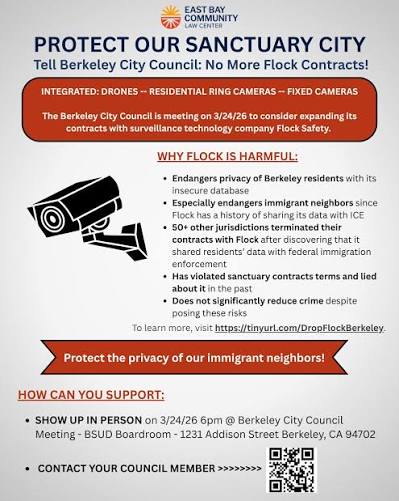
But, as Berkeley Speaks detailed in our Fall 2025 reporting, this proposal collided with a revelation that Flock had a secret pilot program with ICE, and also that Berkeley’s own Flock data had been searched by another agency for immigration-related records.
These events were terrible timing for the police and their council supporters, and they derailed the council hearing on the expanded contract until the spring of 2026.
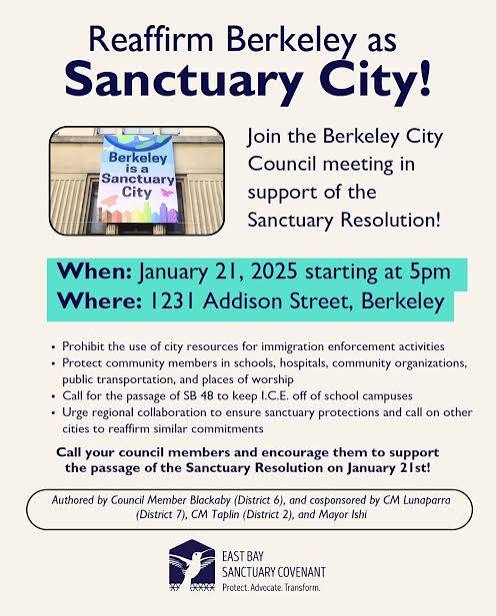
Now the battle over surveillance was joined by the Sanctuary movement, birthed in Berkeley forty years ago to protect immigrants fleeing U.S. wars against popular movements in Central America.
The surveillance proponents could no longer ridicule the opposition for dreaming up an imaginary threat to civil liberties. The debate over mass surveillance took place against the real-life background of violent ICE raids and deportations in Portland, Chicago, Minneapolis, and in Los Angeles here in California, and amid a drumbeat of revelations of Flock sharing local ALPR data with ICE.
The East Bay Sanctuary Covenant and several other immigrant-serving organizations gave clear leadership to the call for No Flock in Berkeley, educating the council and community alike on the harm that a break in the Sanctuary principle could do to immigrants living in Berkeley.
Four city commissions advised the council to either slow their roll on the Flock relationship, or to abandon it entirely. The Police Accountability Board (PAB) detailed significant problems with the selection process, including improperly bypassing competitive bidding to award a sole-source contract, the risks of concentrating on a sole provider; the Commission on Labor cited Flock’s use of digital sweatshop labor in the Philippines in urging the council to pause its contract with Flock
The Peace and Justice Commission called for the cancellation of Flock contracts due to Flock’s repeated sharing of data with immigration authorities and the risk of exposing cloud storage to the Trump administration; the Human Welfare and Community Action Commission likewise called for the cancellation of Flock contracts, saying, “We believe that the City’s reliance on Flock poses greater harm to our community’s safety than it purports to provide.”
A one-two punch to the proposal’s chances at council came in the final days before the May 7 vote. On May 5, El Cerrito, Berkeley’s neighbor just to our north, voted to end its own contract in response to years of data breaches allegedly caused by technical glitches. The breaches allowed out-of-state agencies including the US Postal Inspection and the Veterans Administration Police to view ALPR data, which is strictly forbidden by California state law SB34.
That same day, the Daily Cal published the leaked memo from the City Attorney’s Office (CAO). Berkeley Speaks posted a rapid update summarizing Attorney Brown’s candid comments:

- Ms. Brown warned the council that, based on the technology, the poorly drafted contract language, and developing law, it is possible that lawsuits could potentially cost the City as much as $30-$60 million.
- The attorney ran through a list of dangerous design features, serious mistakes including improper data sharing, data corruption, and massive data leaks to unauthorized agencies including ICE.
- The secret City Attorney opinion shows an impressive record of concerns about the risks that the proposed contract may put on the City. It should be understood that many of these risks have been repeatedly raised to the council by the Police Accountability Board and community members, who were given only lip service by the majority of the council.
- For example, the City Attorney’s Office (CAO) understands that it is part of Flock’s business model for its clients to share as much data with each other as possible, which creates a conflict of interest with Berkeley’s data privacy and Sanctuary commitments. The Conclusion of the CAO’s opinion reads in full:
-
- “Contracting with Flock and purchasing all the products PD is requesting carries some legal risks as outlined above.
“Although the City can mitigate some of those risks through contractual protections and improving use policies and acquisition reports, this technology carries inherent legal risks that cannot be entirely mitigated.”
- “Contracting with Flock and purchasing all the products PD is requesting carries some legal risks as outlined above.
The pressure was hot on the council. Already in March, both CM’s Ben Bartlett and Igor Tregub spoke publicly about the overwhelming opposition they heard from their constituents to stop Flock. On the council, the committed ‘No’ votes had grown from just CM Lunaparra last fall to four in May, including Mayor Ishii.
It don’t mean a thing if it ain’t got that swing (vote)
At the eleventh hour, after hours of listening to firm opposition to Flock, Council member Brent Blackaby delivered his surprise “compromise” proposal. The atmosphere on the council was politically polarized. The police proposal had four solid backers, with four other members committed against Flock. As the chair of the council’s Public Safety Committee, Blackaby had given support to the proposal, even after earlier decrying it while serving on the Police Accountability Board. He was effectively the swing vote, able to provide a win to either side. But which way would he swing?
Blackaby agreed to reject the expansion of the Flock contract, accepting the PAB recommendation to issue an RFP. He did, however, include extension of the current ALPR contract with Flock for one year.
As the smoke cleared, numerous questions remained unanswered. Was this a win for those concerned about surveillance, in particular Flock, and Sanctuary for immigrants? Was it a draw? Did it make everyone happy—or anyone?
It is certain that the rejection of the sole-source Flock contract extension is not the final word, but rather just one more step in Berkeley’s journey. Flock could still be awarded the contract through the competitive RFP process.
It appears likely that this could take place quickly, within 2026, especially as the use policies for these technologies are being approved this Spring. With a council election this November, the balance of the council could shift; proponents have an incentive to speed the process before they lose another vote.
Even so, Sanctuary and privacy activists are celebrating their strong showing of community power. At an organizers’ evaluation late in May, people from diverse organizations shared that they accomplished more than just bringing hundreds of people to demand the council reject the Flock contract. The No Flock campaign touched a nerve in the community as a whole. One activist said, “Berkeley was inspired by the example of Minneapolis and stopped the ICE train.”
Ben Franklin was asked at the close of the Constitutional Convention in 1787, “what have we got, a monarchy or a republic?” He famously answered, “A republic, if you can keep it.”
On May 7 in Berkeley, the campaign for privacy and Sanctuary won the day. Over the next few months, the movement may keep that victory, if it can ban all forms of mass surveillance.
Berkeley Speaks also recommends:
- Berkeley Immigration Collaborative: https://www.berkeleyside.org/2025/09/05/opinion-flock-berkeley-surveillance-cam-data-trump-and-ice
- Kitty Calavita: Flock’s lack of integrity and its financial connections to Trump and ICE https://docs.google.com/document/d/15SDtl18ivWM_lm6Be8XeiEoAi_zQmgzc/edit
- Kitt Saginor: “Surveillance in Berkeley — and more coming???” https://tinyurl.com/4ynbyrs9
Related Berkeley Speaks coverage:
- Stop Local Collaboration with Immigration
- Berkeley leaders: “Why I do not support Flock”
- Drop “Flock” in Berkeley: May 7
- How Can We Stop Trump’s Immigration Madness?
- Stand up! for the things you know are right.